
【For Organizers】Key Advantages and Disadvantages to Know Before Hosting an Offsite Meeting
2025.11.14
column
Table of Contents
- Introduction | Why Off-Site Meetings Now?
- What Is an Off-Site Meeting?
- Why You Should Consider It: Key Benefits
- Potential Drawbacks and Points to Keep in Mind
- Top 5 Recommended Venues for Off-Site Meetings
- Conclusion | Change the Place, Change the Dynamics
Introduction | Why Off-Site Meetings Now?

With the rise of diverse workstyles and the widespread adoption of remote work, many companies are beginning to feel a decline in team communication, cohesion, and mutual trust among employees. In response, off-site meetings are gaining attention as a powerful solution.
An off-site meeting is a gathering—such as a meeting or workshop—held away from the usual workplace. By stepping into a natural or unconventional environment, participants can engage in more relaxed and open discussions. The change of scenery fosters honest dialogue and helps build stronger personal connections, making it highly effective for team building.
More than just “changing the location of a meeting,” off-site meetings are now seen as a valuable opportunity to nurture trust, spark creativity, and strengthen team dynamics.
What Is an Off-Site Meeting?

An off-site meeting is a gathering—such as a meeting or workshop—held outside the usual office environment. Often set in nature-rich surroundings or unique venues, these meetings take place in non-routine spaces that encourage fresh perspectives and open communication, leading to significant shifts in team dynamics.
By temporarily setting aside formal titles and hierarchical roles, participants can interact in a more relaxed, egalitarian atmosphere. This makes it easier to express honest thoughts and fosters deeper mutual understanding. Engaging in conversations and activities outside of regular work settings also allows team members to connect with one another’s personalities and values, cultivating empathy and trust.
Sharing this kind of experience helps break down internal barriers and improve day-to-day communication. Ultimately, what makes off-site meetings truly valuable is not just the content discussed, but the opportunity to rebuild and strengthen relationships—something that can’t always be achieved in a typical office setting.
Why You Should Consider It: Key Benefits

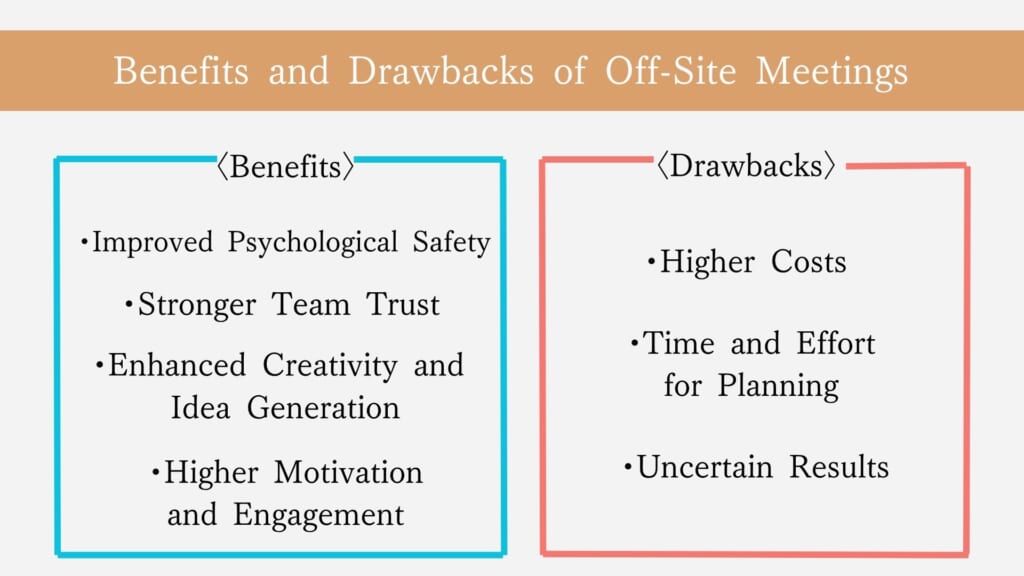
①Enhancing Psychological Safety
One of the most significant benefits of off-site meetings is the improvement of psychological safety within the team. In a typical office setting, employees may hesitate to speak up due to hierarchical pressure or company culture. In contrast, a relaxed, non-routine environment eases these pressures and encourages more open, honest communication. When people feel free to express their thoughts regardless of position, trust increases and the quality of dialogue improves. Creating such an environment intentionally is vital for both innovation and building a healthy organizational culture.
②Strengthening Team Trust
Off-site meetings go beyond the meeting room — they include shared experiences like travel, meals, and informal time together. These moments help reveal team members’ personalities and values, often hidden in everyday work life. As people connect on a more personal level, empathy and mutual understanding naturally grow. Spending time together in a flat, non-hierarchical atmosphere fosters trust, which later enhances teamwork and communication back in the office.
③Boosting Creativity and Innovation
Changing the physical environment can unlock creativity. Being surrounded by nature or in a unique venue helps free the mind from routine thinking, making it easier to generate fresh, innovative ideas. Such spaces naturally put the brain in a relaxed state, encouraging more flexible and positive thinking. For teams caught in the fast pace of daily operations, off-site meetings offer a rare opportunity to reset, focus on fundamental challenges, and create new value.
④Increasing Motivation and Engagement
Off-site meetings are special experiences that bring people closer together by offering a break from routine. Interacting outside of work helps employees discover new sides of their colleagues, deepening mutual understanding and empathy. These improved relationships positively affect collaboration and communication back at the workplace. Moreover, environments where people can speak freely build a stronger sense of trust and safety, which boosts both motivation and engagement. Time spent connecting on a human level is often the key to unlocking the full potential of an organization.
Potential Drawbacks and Points to Keep in Mind

①Higher Costs
Off-site meetings typically involve higher costs than regular in-office meetings, including venue rental, transportation, and meals. Depending on the location, there may also be additional fees for equipment use or program facilitation. When considering implementation, it’s important to carefully weigh the expected benefits against the associated costs. Designing the event with a clear purpose, a focused number of participants, and a cost-effective approach is essential to maximizing ROI.
②Greater Planning Burden
Unlike standard meetings, off-site meetings require extensive planning—selecting a venue, arranging transportation, organizing meals, and designing the schedule, among other tasks. For organizers, especially those juggling day-to-day responsibilities, the workload can be substantial. Coordinating with local venues and communicating detailed information to participants also adds complexity. To ease the burden, consider leveraging professional event planners, using ready-made templates, and distributing responsibilities across a team. Streamlining the preparation process is the first step toward a successful event.
③No Guaranteed Results
While off-site meetings offer many benefits, they don’t automatically lead to success. If the objectives are unclear, the event risks becoming nothing more than “a meeting in a different location,” which can leave participants feeling underwhelmed. What’s crucial is defining the intended outcomes and target audience in advance, then building a thoughtful program around them. The key to meaningful results lies not in the venue alone, but in the intention and content behind the meeting. Simply changing the setting isn’t enough — success depends on creating experiences that drive real engagement and transformation.
Top 5 Recommended Venues for Off-Site Meetings

Kiyosumi Gardens
Tokyo | Koto Ward
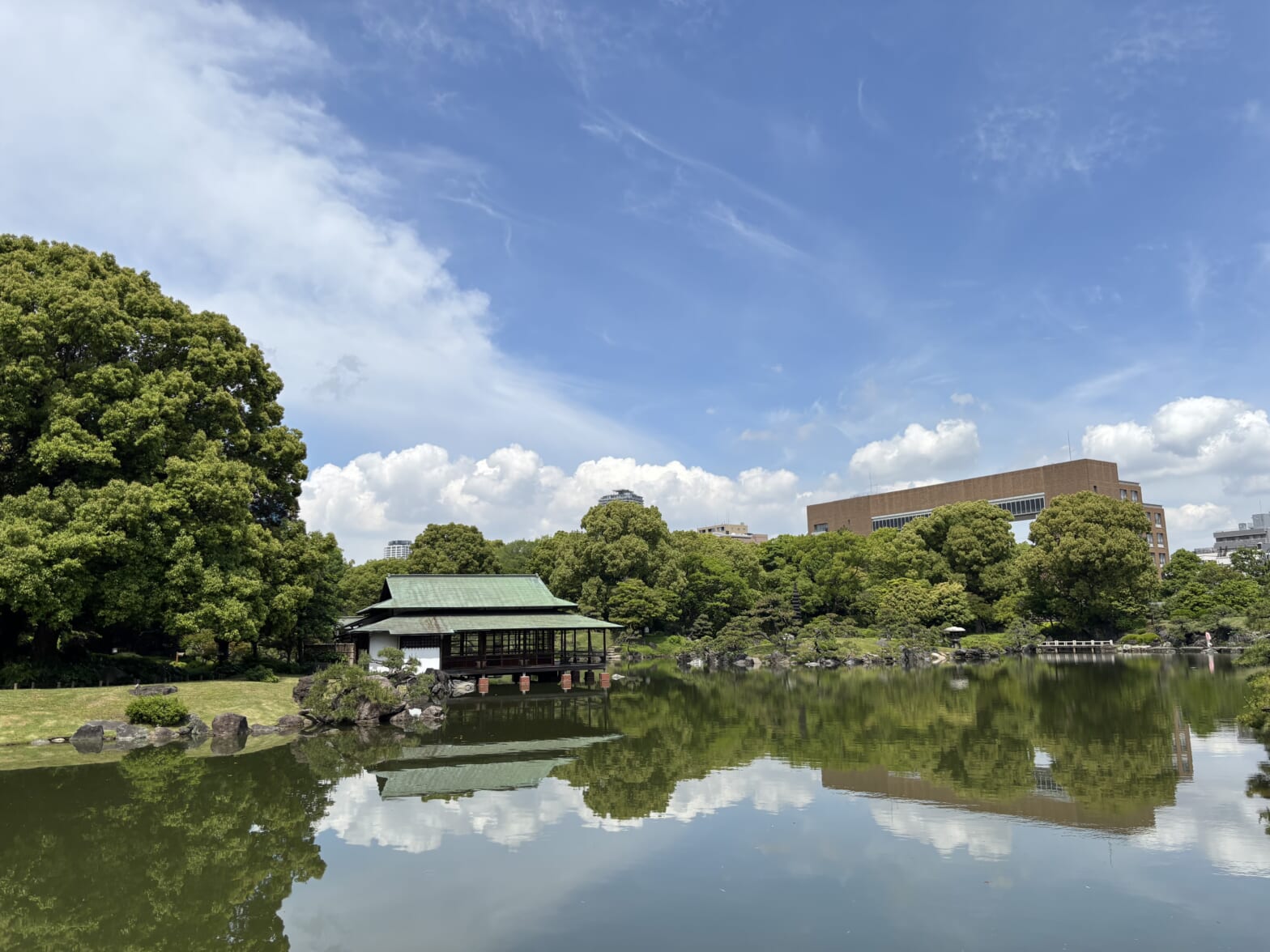
Designated as a Place of Scenic Beauty by the Tokyo Metropolitan Government in 1979, Kiyosumi Gardens is a traditional Japanese strolling garden featuring a central pond, man-made hills, and carefully selected ornamental stones. Located in the heart of the city, it offers an unexpectedly serene and beautiful setting where guests can enjoy the seasonal landscapes while hosting a truly special off-site meeting or reception.
The Taisho Memorial Hall can accommodate up to 150 guests, making it ideal for seminars and meetings during the day. After closing hours, the garden can be reserved for private evening gatherings. Unique experiences such as guided garden tours or toasts on the lawn allow guests to immerse themselves in both nature and Japanese culture. This venue is highly recommended for those seeking an extraordinary and tranquil space in central Tokyo.
Click here for venue details
Funatsuru Kyoto Kamogawa Resort
Kyoto | Kiyamachi District
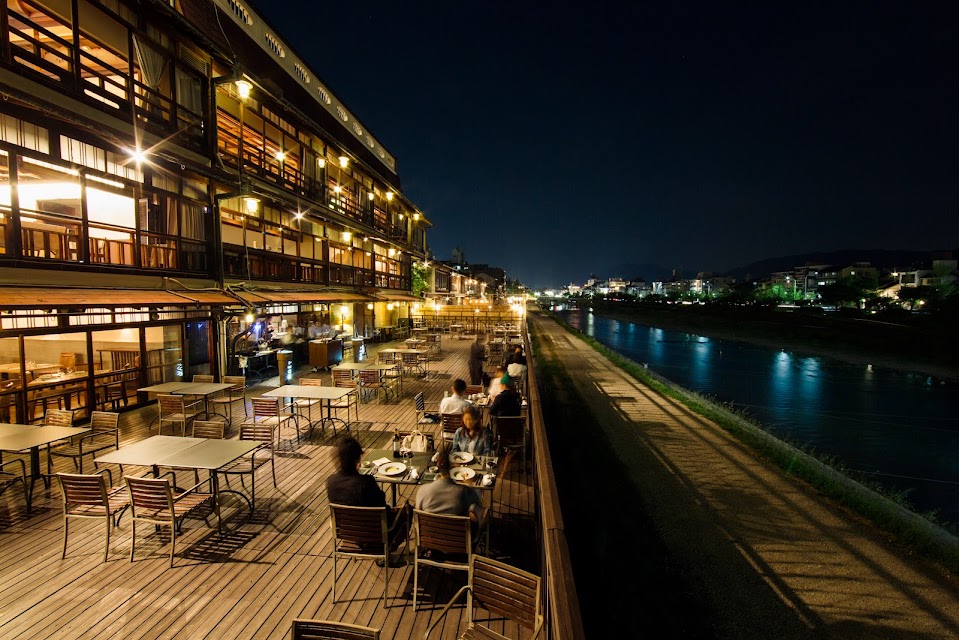
Originally established in the third year of the Meiji era, Funatsuru Kyoto Kamogawa Resort is a historic five-story wooden building that once served as a prestigious traditional ryotei inn along the Kamogawa River in Kyoto. Registered as a Tangible Cultural Property in 2012, the venue blends classic Japanese aesthetics with modern design, making it ideal for a wide range of off-site uses—from corporate meetings to social gatherings.
Guests can enjoy the seasonal beauty of Kyoto, such as cherry blossoms along Kiyamachi in spring and traditional kawadoko riverside parties in summer. The spacious venue accommodates up to 160 guests and offers a unique experience enhanced by Geiko and Maiko performances and a fusion of Japanese and Western cuisine. With the Higashiyama mountain range in the backdrop and the Kamogawa River at its feet, it offers a memorable and distinguished setting.
Osaka Guest House at Nishinomaru Garden, Osaka Castle
Osaka Prefecture | Osaka Castle
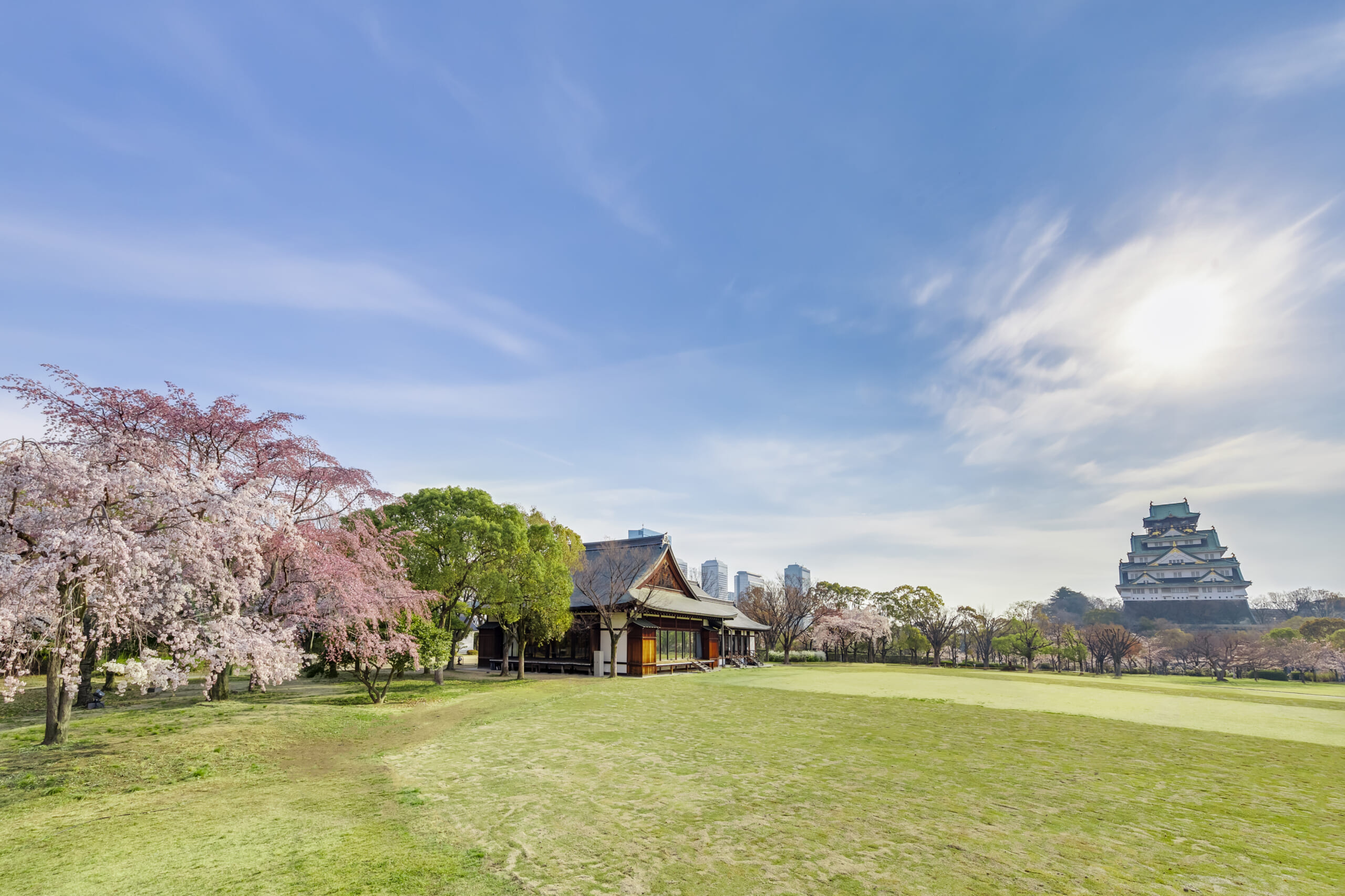
Nestled within the scenic Nishinomaru Garden of Osaka Castle, the Osaka Guest House has hosted high-profile international conferences such as APEC and the G20. The refined Japanese-style architecture, paired with panoramic views of Osaka Castle across the garden, inspires a level of focus and excitement unattainable in ordinary meeting rooms.
Surrounded by serene greenery, the venue is ideal for strategic planning sessions, executive retreats, and team-building events. Meals and social gatherings can be held in the same location, allowing for seamless transitions between business and networking, all within an elegant and tranquil environment.
Osaka City Central Public Hall
Osaka Prefecture | Osaka City

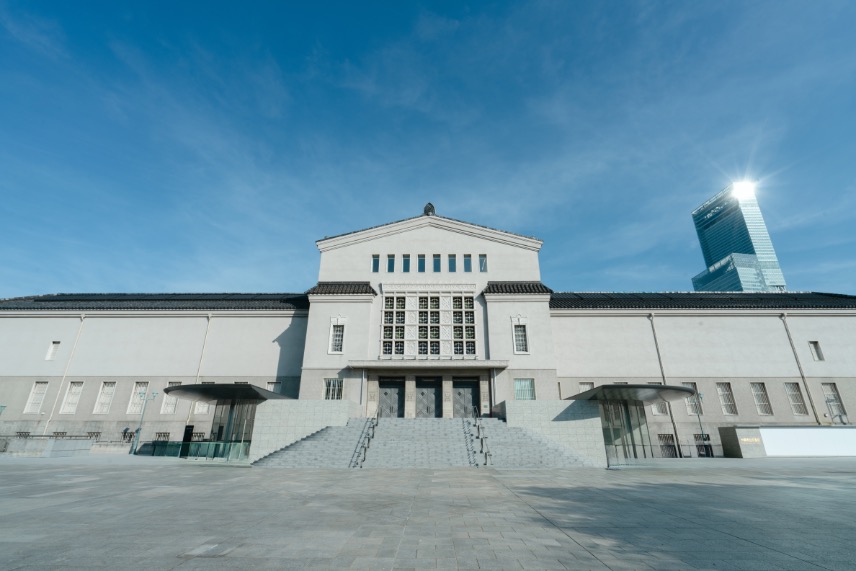
Renowned for its beautiful Neo-Renaissance façade and designated as an Important Cultural Property of Japan, Osaka City Central Public Hall has been a symbol of culture and the arts in Osaka since its completion in 1918. With over a century of history, it provides an exceptional setting for off-site meetings, award ceremonies, and large-scale conferences.
The venue features a grand hall that accommodates over 1,000 guests, as well as medium and small meeting rooms adorned with stained glass, and a former VIP room that exudes historic elegance. These various spaces can be flexibly combined to suit the event’s purpose.
A day spent in this prestigious and elegant venue is sure to become a memorable experience for all participants.
The Hillside Kobe
Hyogo Prefecture | Rokko
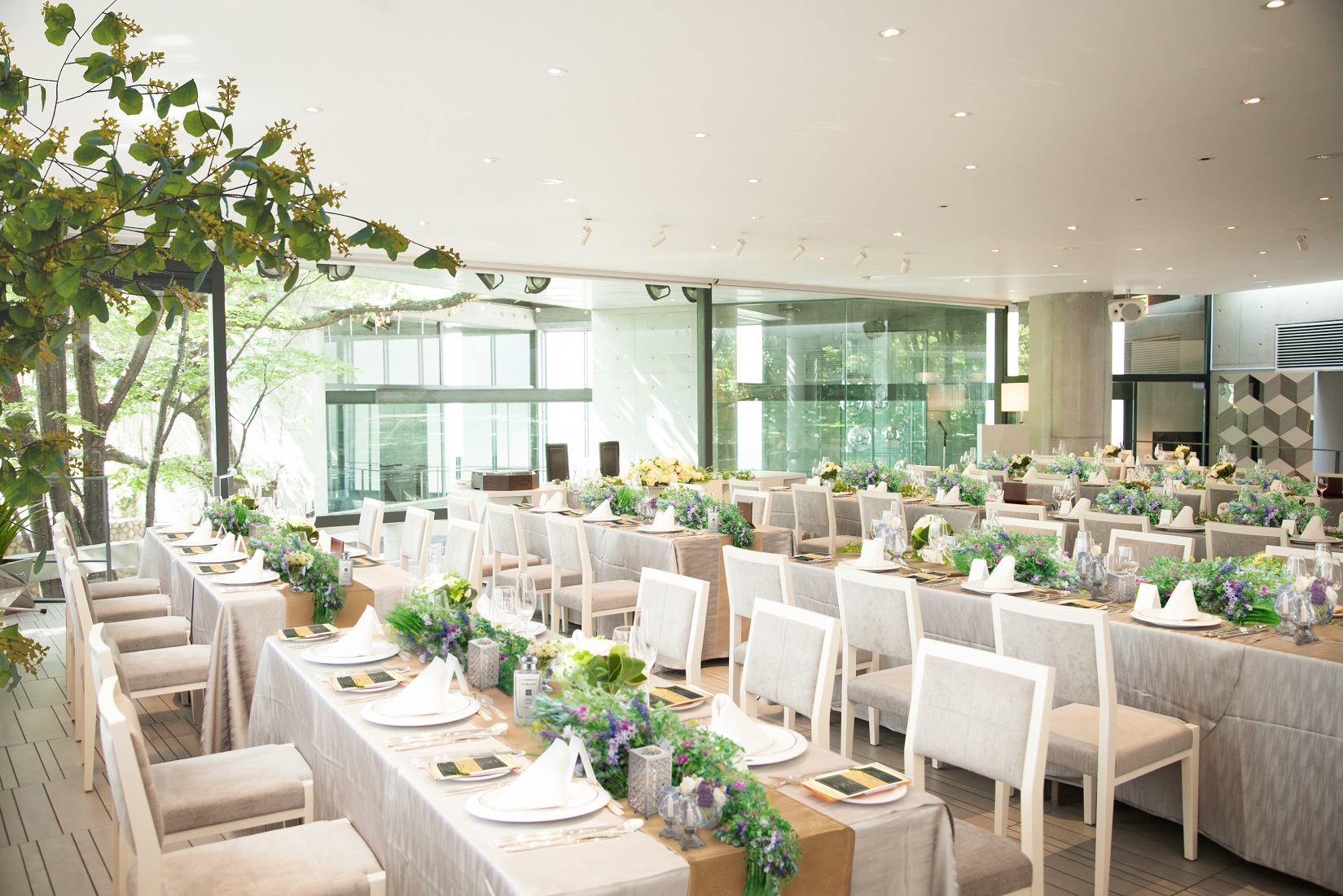
Designed by world-renowned architect Tadao Ando, The Hillside Kobe is a serene and modern venue where light and greenery harmoniously converge. Nestled in the natural beauty of Mt. Rokko, the architectural elegance of the space fosters focus and creativity, making it an ideal setting for off-site meetings.
Available for exclusive rental, the venue is perfect for team-building workshops, corporate training, and strategic discussions. After the meeting, guests can enjoy a sophisticated reception featuring modern French cuisine with a strong artistic sensibility—creating a comprehensive and memorable experience.
Set apart from the bustle of the city, this quiet location is highly recommended for those seeking a space where new ideas are born.
Conclusion | Change the Place, Change the Dynamics

As we’ve discussed, off-site meetings are a highly effective way to enhance internal communication, improve operational efficiency, and strengthen team relationships. Holding these meetings in unique, non-routine settings helps participants shift their mindset naturally, encouraging deeper conversations and the generation of new ideas.
At UNIQUE VENUES OF JAPAN, we offer full support—from planning to on-the-day operations—for hosting events in historically significant buildings and culturally valuable venues. Let us help you create truly special moments in truly special spaces.
PLACE
Find a venue
Spend time with your loved ones,
at a one-of-a-kind location
where you can experience Japanese culture.